
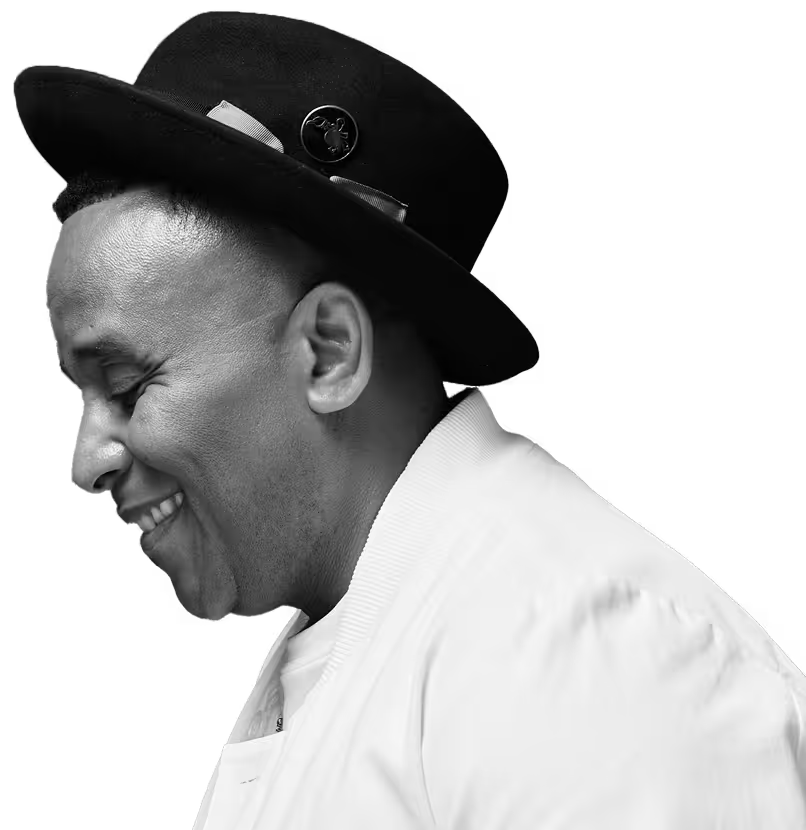

Welcome to How We Win.
Every few weeks, I’ll share my thoughts on movement strategy, politics, and the fight ahead. My previous post, on media consolidation and authoritarian power, can be found here.
If you're not already subscribed, make sure to sign up.
Today, we’re seeing endless raids and abductions, military mobilizations against our own people, government defunding and government corruption at the grandest scale.
It may be tempting to think of all these events as the culmination of a years-long strategy of right-wing ascendance. The right wing controls all three branches of government. Trump has been the moral and electoral center of the Republican party for nearly a decade. Now they’re cashing in.
But what we must understand is that what they’ve done is only half the story—the second half is about what they’re going to do. Everything they are doing now is setting up the next phase: a way to take even more power in the years to come. But there are ways we can stop them.
For decades, I’ve been on the battlefield with various factions of the right-wing movement, not only fighting the opposition but learning how they function. Their primary goal is power—the power to set the rules for how everything works, and to determine who it works for.
But they also know that a majority of people will reject them at some point: protests, approval ratings, elections, local and state laws, lawsuits, nonviolent resistance to certain policies, and even the targeting of corporate enablers who allow them to do what they do. In order to keep moving forward with their agenda, despite that rejection, they need to do three things:
With this control, they want to make their political power permanent, neutralize all meaningful threats to that power, and make the rich and powerful exponentially more rich and powerful.
And there is one thing they need to do all of this: racism. They can’t win without it.
Of course, racism is an end unto itself for the right wing. But they also use it as a weapon in order to achieve their three goals right now:
They don’t just use racism for distraction. They need it. Without it, the project collapses. Racism is what allows them to consolidate control, while also keeping large portions of the public convinced that they’re defending freedom, rather than dismantling it.
What’s the first thing we need to do to fight back? Make sure we’re not doing their work for them. And that’s not always easy. Even those who oppose MAGA can sometimes reinforce the very narratives that make MAGA attacks on Black people possible.
I often get pushback when I say this to people, especially non-Black folks. It’s hard to hear that we may be contributing to the very dynamic we are trying to defeat. But failing to honestly address it—and not investing in the money, infrastructure, and resources it takes to change it—will hurt us in the long term.
During Covid, I put out a paper on this very topic. It focused on how the language journalists, politicians and others were using about race—even if well-intentioned—was enabling injustice. Their language was full of quiet traps, headlines like “Black businesses didn’t get loans” and “Black people were less likely to be vaccinated” and “Black communities are being hit hardest.”
At first glance, none of those sentences sound malicious. They sound like facts. And technically, they are. But they aren’t the truth. They don’t tell us what we need to know. The subject of each sentence is Black people. The action is about their failure. Passive voice obscures the story.
The real story is not that “Black businesses didn’t get loans” but that banks denied loans to Black businesses. They denied Trump’s Paycheck Protection Program loans to Black businesses in favor of white businesses, which was a step toward the third goal I listed above: economic consolidation. This happened even when consciousness of racial injustice was at its peak in 2020. The idea that Black businesses weren’t worthy was still deeply entrenched, whether people were advancing that idea intentionally to serve their agenda or unintentionally by default. And all those who committed these acts of discrimination were let off the hook by stories about the program that blamed its disparities on Black people themselves. Those lies affected Black businesses, business owners, customers and communities in ways exacerbated economic inequality.
The same was true when news media often let health systems off the hook for failing to reach and serve Black communities. Instead, they framed the problem as being about Black people’s health issues, or their failure to get vaccinated. Some thought they were trying to help by drawing attention to those issues, but inevitably it draws the wrong kind of attention.
Today, I see us entering another phase of the same pattern. Black unemployment is rising. The Trump administration laid off thousands of government employees, jobs that have long been the most stable path to a middle class for Black people. Meanwhile, private sector employers are canceling DEI programs that aim to disrupt persistent racial bias, which disproportionately allows white employers to discriminate against Black workers.
People should talk about unemployment and social safety net cuts as problems, and talk about racial disparities as problems. But if we don’t identify who is causing those problems, we inadvertently play into the hands of the right wing by implying it’s a problem with Black people themselves. That only helps them advance their goals of consolidating economic power, and ultimately more political power, which will hurt all of us.
Despite the fact that the Trump administration is openly racist, many people on our side still tiptoe around the impact its actions have on Black lives, and how intentional that impact is. Like clockwork, I see story after story full of rhetoric that treats racial inequality as natural or inevitable—or worse, the fault of Black inadequacy instead of the active choices made by people in power.
Take this article about unemployment from The New York Times that I read recently, which seemed to undercut the very point it was trying to make.
“Black households were the only racial group last year in which median income fell and the poverty rate rose, according to the Census Bureau.”
Through this lens, Black people are experiencing something, but no one is responsible for it.
The writer might be sympathetic toward Black people, but they are implicitly blaming Black people for the results of the intentional actions taken by the Trump administration. If they are not tracing results back to choices—to the decisions of the people in power—they are not telling the true story and they are reinforcing the story that makes the right wing more powerful.
If you’re reading this, you’re probably interested in fighting the increasingly authoritarian right wing. To do that, we can’t use frames that feed their narrative. It’s imperative that, in our effort to expose injustice we don’t inadvertently reinforce its logic.
Here are a few things to keep in mind:
Fighting racism isn’t side work or moral cleanup. It’s power work. It’s how we stop the theft of resources, the manipulation of fear, and the rewriting of history that make authoritarianism sustainable.
This is the first step: not playing into the hands of the right wing and making their work easier. We cannot echo language that sets up Black people (or anyone) to be the excuse for their consolidation of power. The next step is being proactive about explaining how what the right wing is doing now is a set-up for their next steps. We cannot hide from the way they are using racism to justify authoritarianism.
And then we must continue the work of disrupting or fortifying against the attacks on elections, speech and public resources. But that work will be easier if we focus on neutralizing the racism they require to do it.
— Rashad
No spam. Unsubscribe anytime.


